
🔍 Introduction
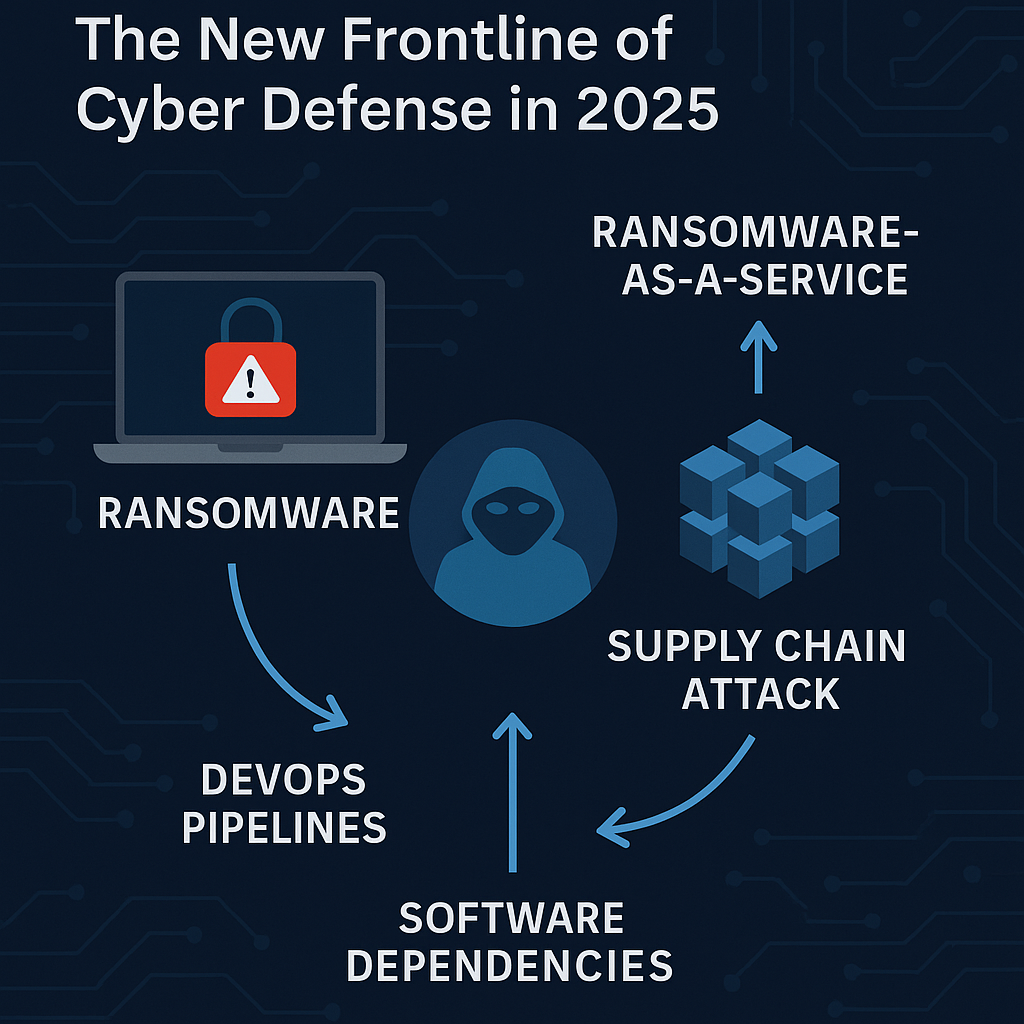
Ransomware is no longer about encrypting files — it’s about breaking the trust chain of entire ecosystems.
In 2025, threat actors are combining ransomware tactics with supply chain compromises, targeting DevOps pipelines, build servers, and software dependencies instead of individual machines.
According to the World Economic Forum Cybersecurity Outlook 2025, nearly 60% of ransomware incidents now involve a third-party or supply chain entry point.
Attackers understand one thing clearly: compromise the build once, and you compromise thousands of deployments.
🧨 1. Ransomware-as-a-Service (RaaS) Becomes Industrialized
Gone are the days of lone ransomware hackers. In 2025, Ransomware-as-a-Service (RaaS) operates as a full business model — offering subscription-based attack kits, AI-driven phishing templates, and cryptocurrency laundering networks.
- Ransomware gangs such as LockBit 3.0 and BlackCat (ALPHV) are leveraging GenAI for social engineering.
- Attackers target enterprise cloud backups, encrypting both primary and recovery environments.
- Some even execute “double extortion” — stealing and publishing sensitive data if ransom demands aren’t met.
Image:
Key Insight:
The 2025 Verizon Data Breach Report noted that 90% of ransomware incidents involved stolen credentials, weak identity governance, or exploited supply-chain trust.
🧩 2. Supply Chain Attacks — From Code to Cloud
Supply-chain attacks now represent the most strategic form of cyber warfare. Instead of targeting production servers, attackers compromise the development and build ecosystem — before code even ships.
🚨 Attack Examples:
- CI/CD Pipeline Compromise — Injecting malicious code into Jenkins or GitHub Actions.
- Container Registry Breach — Uploading tampered base images to public repositories.
- Dependency Poisoning — Inserting malicious packages into NPM, PyPI, or Maven (typosquatting).
- Update Hijacking — Exploiting build automation to push infected “official” software updates.
Example: The 2025 “PyStealer” campaign inserted credential-stealing code into 150+ Python packages that collectively had 8 million downloads.
Image: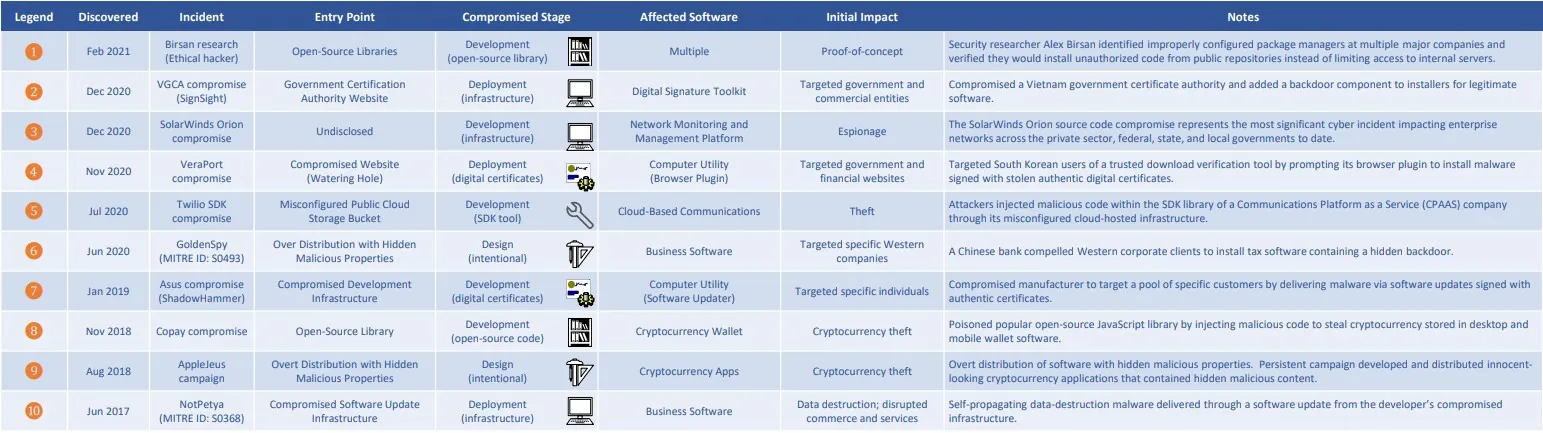
🛠️ 3. Why DevOps Pipelines Are the Perfect Target
DevOps systems are inherently trusted — they deploy code, manage credentials, and control production systems.
That makes them a single point of failure in modern ransomware campaigns.
Common Weaknesses:
| DevOps Component | Threat Type | Attack Vector |
|---|---|---|
| CI/CD Runner | Credential reuse | Malicious PR or insider commit |
| Container Registry | Supply chain breach | Infected image or dependency |
| Artifact Repo | Update hijacking | Fake library version release |
| IaC Repo | Misconfiguration injection | Terraform code alteration |
Attackers exploit CI/CD trust relationships to insert ransomware payloads that get deployed automatically.
Image:
⚙️ 4. Evolution of Ransomware Payloads
The ransomware of 2025 is stealthier, faster, and cloud-native.
Modern strains now:
- Target Kubernetes volumes and S3 buckets
- Spread through IaC templates and Helm charts
- Use AI-based encryption keys to avoid pattern detection
- Disable EDR/monitoring agents automatically
Emerging Trend: RansomOps — multi-stage ransomware operations involving recon, persistence, encryption, and exfiltration across hybrid cloud systems.
Image:
🧠 5. Mitigation: Building a Ransomware-Resilient Pipeline
To counter modern ransomware and supply-chain attacks, organizations must adopt DevSecOps-by-default practices.
🔸 Secure the Build Chain
- Digitally sign builds and enforce signature verification (Sigstore, Cosign).
- Implement Software Bill of Materials (SBOMs) for every release.
- Use isolated build agents with no internet access for production jobs.
🔸 Harden the CI/CD Environment
- Enforce MFA and role-based access for pipeline tools.
- Use short-lived credentials and auto-rotate tokens.
- Regularly scan pipelines for exposed secrets using tools like Trivy, Gitleaks, or Snyk.
🔸 Defend Against Lateral Propagation
- Implement least privilege across cloud and CI/CD identities.
- Use network segmentation to isolate dev, staging, and production.
- Deploy ransomware behavior detection via EDR and behavioral AI.
🔸 Backup & Incident Response
- Keep offline, immutable backups of all build artifacts and IaC templates.
- Test restoration regularly — automation isn’t enough if recovery fails.
Image: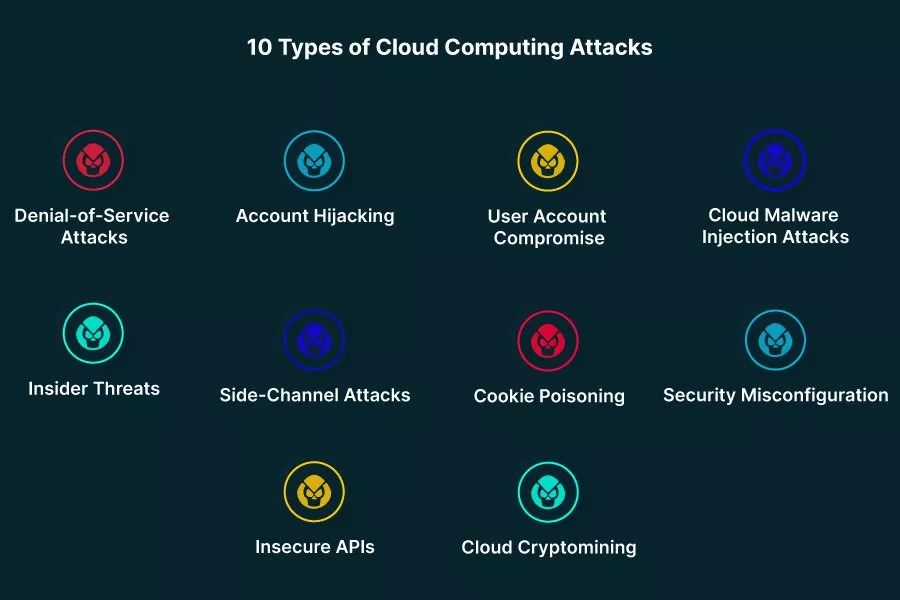
⚡ 6. Real-World Incident: Supply Chain Attack at Scale
In mid-2025, a major DevOps platform was breached via a compromised dependency in its open-source SDK.
The attacker inserted a ransomware payload that encrypted thousands of downstream customers’ build environments.
Key findings from post-incident forensics:
- Malicious dependency downloaded 9M+ times
- Encrypted pipelines triggered automatically via CI jobs
- Damage extended to over 3,200 enterprises globally
This event triggered new regulatory requirements for Software Supply Chain Transparency (SSCT) across multiple nations.
🧾 Key Takeaways
- Ransomware has evolved — it’s now a supply-chain weapon, not just a file encryptor.
- The CI/CD pipeline is the new attack surface.
- SBOMs, digital signing, and zero-trust build environments are essential defenses.
- Regular backup validation and air-gapped repositories remain your best recovery strategy.