
I usually don’t get excited about Kubernetes version numbers.
Most releases come, we skim the changelog, upgrade when forced, and move on.
But v1.35 made me stop for a bit.
Not because it’s flashy.
Because it feels… mature.
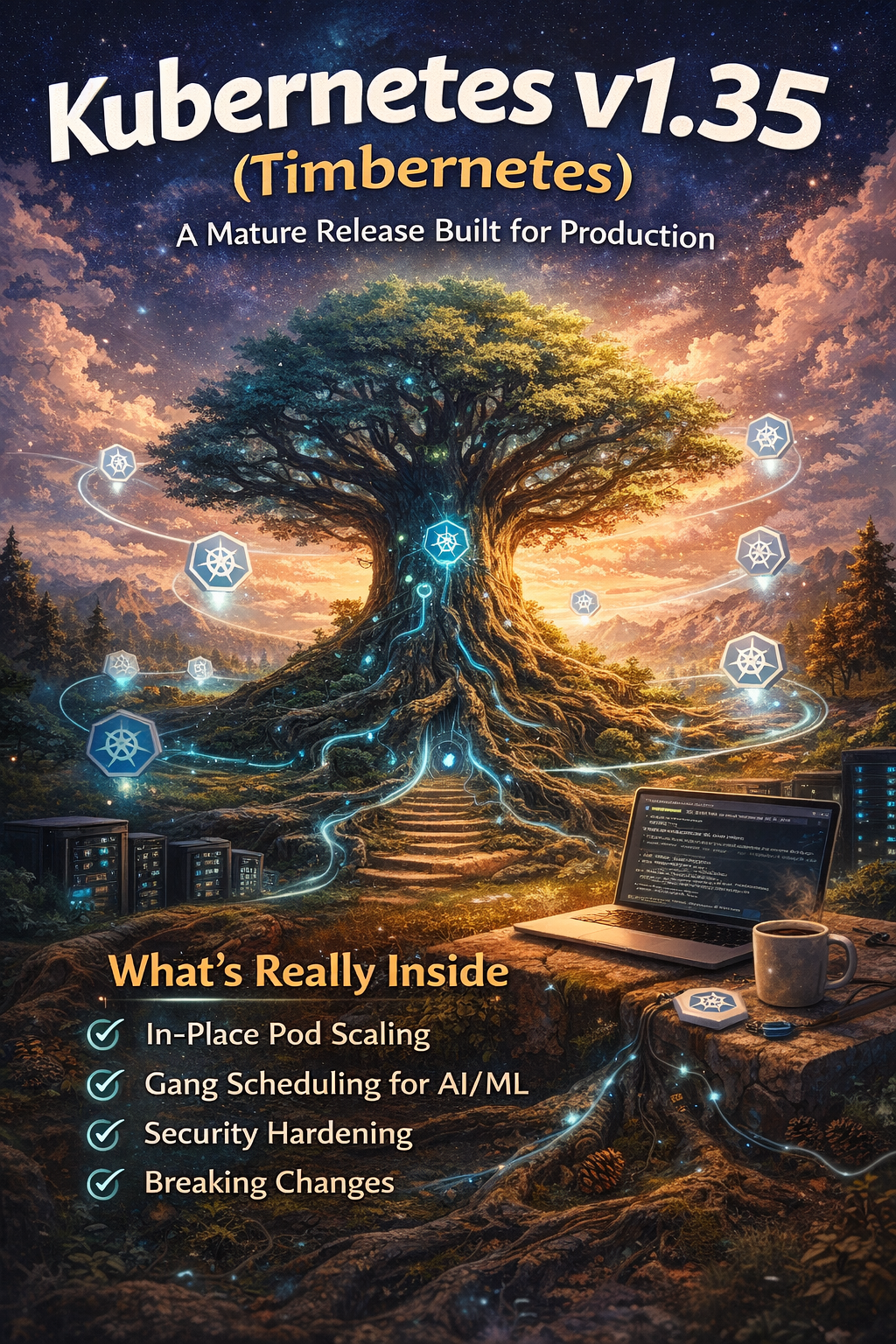
Kubernetes v1.35 was released on December 17, 2025, and it’s called Timbernetes — The World Tree Release. The name comes from Yggdrasil in Norse mythology. A tree that grows slowly, connects everything, and survives storms.
Honestly, that metaphor fits Kubernetes perfectly.

This Release Isn’t Loud — And That’s the Point
v1.35 comes with 60 enhancements.
Yes, that sounds impressive:
- 17 stable
- 19 beta
- 22 alpha
Built by more than 400 contributors.
But numbers don’t run production clusters.
Behavior does.
And v1.35 is mostly about behavior.
In-Place Pod Scaling (This One Actually Matters)
Let me start with the feature everyone has wanted for years.
You can now change CPU and memory for a running Pod without restarting it.
If you’ve ever run:
- databases
- message queues
- stateful services
You know how painful restarts are.
This change alone removes a lot of “planned downtime” excuses we’ve been living with.
For me, this is the most important part of v1.35.
Scheduling Finally Understands Real Workloads
Gang Scheduling (Alpha)
If you’ve touched AI or ML workloads, you know the pain.
Half your Pods start.
The other half wait.
Resources get wasted.
Gang Scheduling fixes this idea-wise:
Either everything starts together — or nothing starts.
It’s still alpha, but the direction is clear.
Kubernetes is no longer pretending all workloads are stateless web apps.
Small Changes That Make Life Easier
There are features that don’t sound exciting, but you feel them immediately.
- You can change resources on suspended Jobs without deleting them
- You can restart a single container inside a Pod
These aren’t headline features.
They’re operator sanity features.
Security Is Becoming Boring (In a Good Way)
Two things stood out to me:
- Automatic Pod certificate rotation
- User Namespaces
Both reduce the number of sharp edges.
Less manual work.
Less chance of human mistakes.
Less “why did this suddenly break?” moments.
Kubernetes security is slowly moving from “expert-only” to “default-safe”.
Networking: Less Clever, More Predictable
PreferSameNode
Traffic stays local when possible.
That’s it.
No magic.
But lower latency, fewer hops, and fewer surprises during incidents.
Production loves boring networking.
OCI Artifact Volumes Are Quietly Powerful
Mounting OCI artifacts directly as volumes doesn’t sound exciting.
But for:
- ML models
- shared data
- platform tooling
This cleans up a lot of ugly workarounds.
Platform teams will appreciate this more than app teams.
Now the Part You Can’t Ignore: Breaking Changes
This release also draws a hard line.
If you’re not ready, don’t upgrade.
- cgroup v1 is gone → cgroup v2 only
- containerd 1.x is gone → 2.0+ required
- kube-proxy IPVS is deprecated
- Ingress NGINX community support is ending
Like it or not, the future is:
👉 Gateway API
Kubernetes is telling us very clearly where it’s going.
What v1.35 Really Feels Like
To me, Kubernetes v1.35 feels like this:
“We’re done experimenting. Let’s make this thing reliable.”
Less chaos.
Less clever hacks.
More trust.
Final Thoughts (Not Marketing, Just Experience)
The best Kubernetes version isn’t the one with the most features.
It’s the one where:
- alerts don’t wake you up
- upgrades don’t scare you
- clusters behave the same on Monday and Friday
If v1.35 delivers on even half of this direction,
it’ll be one of those releases people rely on — without talking about it much.
And honestly?
That’s the best kind.