

Kubernetes just dropped version 1.33, and it’s one of the most meaningful releases in recent years. If you manage clusters, run production apps, or work in DevOps, this version comes packed with upgrades that simplify operations, boost performance, and tighten security.
In this blog, we’ll break down all major enhancements in Kubernetes 1.33, explain how they work, why they matter, and how to start using them.
🌟 What’s New in Kubernetes 1.33?
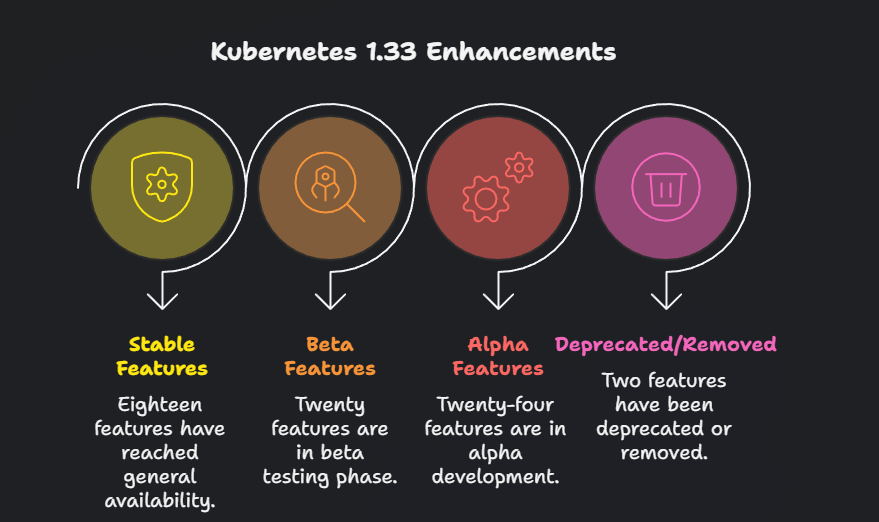
Kubernetes 1.33 (codename Octarine) introduces 64 enhancements:
- 18 Stable (GA)
- 20 Beta
- 24 Alpha
- 2 Deprecated/Removed
The release focuses on:
✔ Better workload reliability
✔ Stronger security
✔ Smoother scaling
✔ Improved job management
✔ Enhanced developer/CLI experience
✔ Support for AI/ML & high-performance hardware
Let’s break it all down feature-by-feature.
🟦 1. Native Sidecar Containers (Stable)
Sidecars (e.g., logging agents, proxies) now have official lifecycle support.
💡 What’s changed?
Before 1.33, sidecars required workarounds using init containers. Now Kubernetes natively manages sidecar lifecycle.
✔ What you get:
- Sidecars start before app containers
- Stay running throughout the Pod’s life
- Stop after main containers exit
- Fully support probes (liveness, readiness, startup)
- Proper OOM & restart behavior
🧩 Why it matters
- No more hacks
- More predictable pod behavior
- Better for service mesh proxies (Envoy), log shippers, security agents
🟧 2. In-Place Pod Vertical Scaling (Beta)
Resize CPU/Memory of a Pod without restarting it.
💡 What’s changed?
You can update Pod resources using a simple patch:
spec:containers:- name: app
    resources:
      limits:
        cpu: "2"
        memory: "4Gi"
Kubernetes adjusts live — no downtime.
✔ Benefits:
- Perfect for databases, AI workloads, and stateful apps
- Saves cost by avoiding over-provisioning
- Helps respond to unpredictable traffic
🟩 3. Advanced Job Management (Stable + Beta)
A. BackoffLimitPerIndex
Each index in an Indexed Job gets its own retry limit.
B. SuccessPolicy
You can declare custom job success rules like:
- “Mark successful if 90 out of 100 tasks complete”
- “Ignore failed indexes 3, 7, and 22”
✔ Why this is huge:
- Perfect for ML pipelines
- Better resource utilization
- Faster completion times
- Flexible success rules for partial workflows
🟪 4. Security Enhancements
Kubernetes 1.33 adds multiple key security improvements.
A. ClusterTrustBundle (Beta)
Manage all cluster trust anchors (CAs) centrally.
B. Better Kubelet API Authorization (Beta)
Granular control → Reduced attack surface.
C. Bound Service Account Tokens (Stable)
More secure tokens tied to specific Pods.
✔ What this means:
- Stronger workload identity
- Better compliance for regulated environments
- Enhanced auditability
🟥 5. Developer & CLI Improvements
Small improvements → huge productivity boost.
✔ kubectl –subresource (Stable)
You can edit/view subresources directly:
kubectl get deployment myapp --subresource=status✔ Pod metadata.generation (Alpha)
Now Pods track spec changes like Deployments do.
✔ Better IP/CIDR validation
Avoid mistakes like:
192.168.000.005
Perfect for avoiding networking misconfigurations early.
🟨 6. AI/ML & High-Performance Hardware Upgrades
K8s 1.33 brings serious improvements for AI clusters.
A. Dynamic Resource Allocation (DRA) Enhancements
Better support for:
- GPUs
- FPGAs
- Special accelerators
- Partitionable devices
B. NUMA-Aware Scheduling (Beta)
Boosts performance on high-end servers by placing workloads based on memory locality.
C. Asynchronous Preemption (Beta)
Better scheduling efficiency under heavy load.
✔ Who benefits?
- AI/ML workloads
- HPC clusters
- GPU-heavy production workloads
🔵 7. Deprecations & Removals
Only 2 removals this cycle:
- Some legacy APIs
- Some provider-specific behaviors
Always review:
kube-apiserver --helpand
kubectl explain
to ensure compatibility.
🧭 How to Safely Upgrade to Kubernetes 1.33
✔ Step 1: Validate tooling
Check compatibility of:
- CNI (Cilium, Calico, Flannel)
- CSI drivers
- Ingress controllers
- CRDs
- Monitoring tools
✔ Step 2: Staging cluster testing
Test:
- Sidecar lifecycle
- In-place scaling
- Job success policy
- GPU scheduling
✔ Step 3: Upgrade control plane → nodes
✔ Step 4: Incrementally enable new features
✔ Step 5: Production rollout with monitoring
📌 Real-World Use Cases
🟦 Logging/Monitoring
Move from custom sidecar hacks → native sidecar support.
🟧 Databases (MongoDB, Redis)
Resize resources without restarting the Pod.
🟩 ML Training Pipelines
Run large Indexed Jobs with flexible successPolicy.
🟪 GPU Workloads
Better hardware utilization with DRA and NUMA scheduling.
🎯 Final Takeaway
Kubernetes 1.33 is a major leap forward with features that:
- Reduce downtime
- Improve developer experience
- Boost performance for AI/ML
- Strengthen security
- Simplify scaling
- Reduce cluster overhead
If you’re running Kubernetes in production, this release is worth upgrading to — especially for stateful apps, GPU workloads, and complex job pipelines.