
🚀 Introduction
Once upon a time, crypto was about digital coins and memes.
Now, it’s about bringing the real world on-chain.
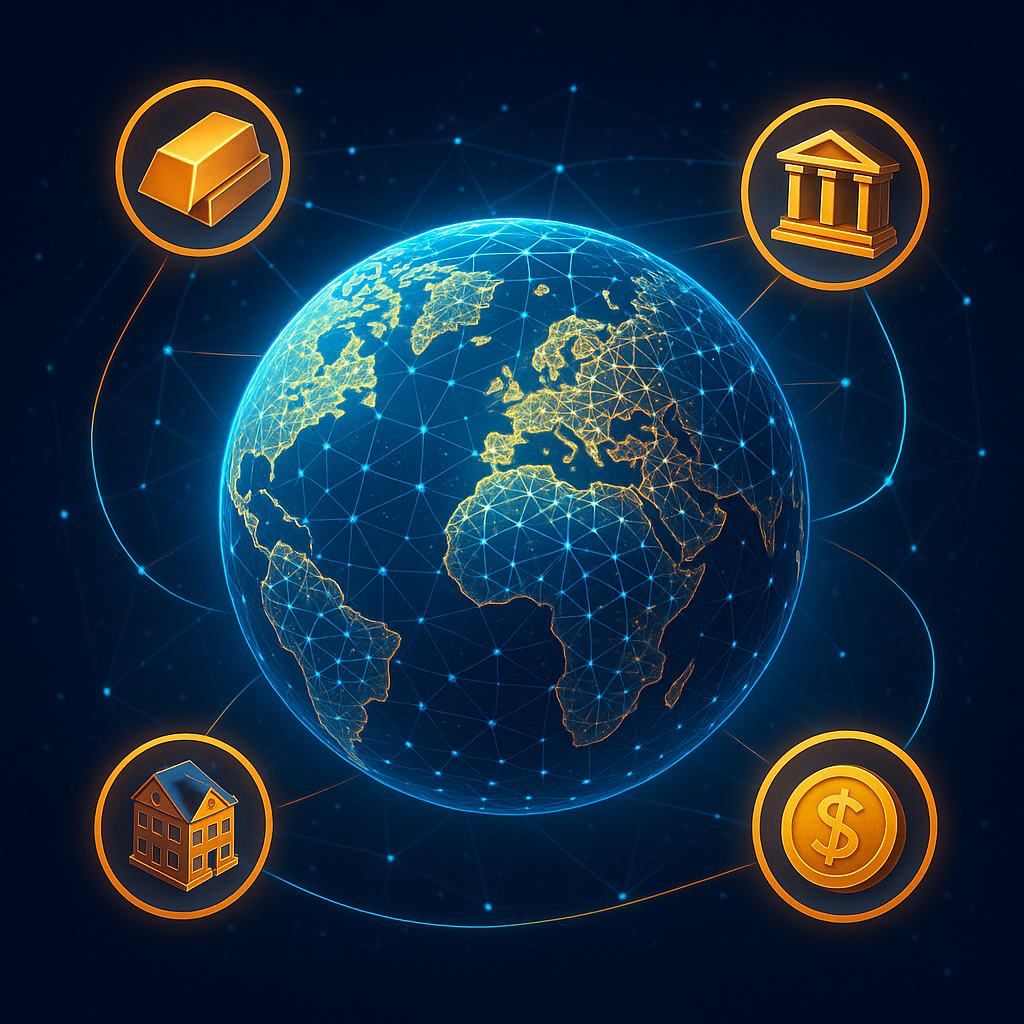
Welcome to the RWA Revolution — where everything from real estate, treasury bills, carbon credits, to fine art is being tokenized on blockchain networks.
This transformation is not just a financial experiment; it’s a fundamental shift in how global assets are owned, traded, and financed.
💬 “Tokenization is the bridge between traditional finance (TradFi) and decentralized finance (DeFi).”
🧩 1. What Are Real-World Assets (RWA)?
Real-World Assets (RWA) refer to physical or traditional financial assets — such as property, commodities, or securities — that are digitally represented as tokens on the blockchain.
These tokens represent ownership rights, income streams, or collateral, and can be traded 24/7 globally — without banks, brokers, or borders.
Examples of Tokenized RWAs:
- 🏠 Real Estate → Property-backed tokens
- 🏦 Government Bonds → Tokenized Treasury Bills (e.g., USDT-Bond on-chain)
- 🪙 Commodities → Gold, Silver, and Oil tokens
- 🌱 ESG Assets → Carbon credits and renewable energy certificates
- 💳 Invoices & Loans → Tokenized debt instruments
⚙️ 2. How RWA Tokenization Works
Here’s a simplified architecture of how a real-world asset becomes a blockchain token:

Each token is backed by a legally recognized claim on the underlying asset, enabling fractional ownership, transparent auditing, and instant transferability.
💡 3. Why RWA Matters for the Global Economy
Tokenization brings real-world liquidity to the crypto ecosystem.
Here’s how:
| Problem (TradFi) | Solution (RWA) |
|---|---|
| High entry barriers | Fractional ownership via tokens |
| Limited liquidity | 24/7 on-chain trading |
| Complex settlement | Instant blockchain transactions |
| Lack of transparency | Immutable public records |
| Cross-border friction | Borderless transfer of tokenized assets |
With RWA, anyone — from a student in Nairobi to an investor in London — can own a fraction of a Manhattan skyscraper or a U.S. Treasury Bill, securely and transparently.
🌐 4. Global Momentum: Who’s Leading the Tokenization Race
The RWA movement is accelerating worldwide:
- 🇺🇸 BlackRock & Franklin Templeton — launched tokenized money market funds.
- 🇸🇬 Singapore’s Project Guardian — central bank-led pilot for RWA integration in DeFi.
- 🇨🇭 Swiss FINMA — pioneering regulatory frameworks for tokenized securities.
- 🇦🇪 Dubai DIFC — adopting blockchain rules for property tokenization.
- 🌍 World Bank — experimenting with blockchain-based bond issuance.
💬 Larry Fink (BlackRock CEO) called tokenization “the next generation for markets.”
🔗 5. The Intersection of RWA and DeFi
DeFi protocols are integrating RWA to add real yield — not just speculative returns.
Examples:
- MakerDAO now holds $3B+ in tokenized real-world assets (e.g., short-term U.S. Treasuries).
- Centrifuge enables businesses to tokenize invoices and borrow against them.
- Maple Finance offers on-chain credit markets using RWA-backed collateral.
This merger creates a hybrid financial model — combining the transparency of DeFi with the reliability of real-world assets.
💰 6. The Benefits of RWA Tokenization
| Benefit | Description |
|---|---|
| Liquidity Creation | Illiquid assets like real estate become tradable |
| Fractional Ownership | Democratizes access to high-value assets |
| 24/7 Markets | No downtime — global access around the clock |
| Reduced Costs | Removes intermediaries and manual processes |
| Programmable Finance | Automate dividends, interest, and ownership transfers |
| Transparency & Security | Every transaction recorded immutably on-chain |
Essentially, tokenization is unlocking trillions of dollars trapped in traditional systems.
⚠️ 7. Challenges and Risks
Like any transformative innovation, RWA tokenization comes with hurdles:
- 🧾 Regulatory Complexity: Jurisdictional differences in securities laws
- 🔐 Custody Risk: Real-world collateral needs secure, auditable management
- 💱 Liquidity Fragmentation: Multiple chains, multiple standards
- ⚖️ Valuation Transparency: Ensuring asset price accuracy and proof of reserves
Global standards — from ISO, FATF, and the BIS — are now being developed to create cross-border RWA compliance frameworks.
🔮 8. The Future: The Global Tokenized Economy
By 2030, analysts predict over $16 trillion in tokenized assets globally — equivalent to ~10% of global GDP.
The line between crypto and traditional finance will disappear entirely.
In the near future, you might:
- Earn tokenized rent from property in another continent
- Invest in on-chain sovereign bonds
- Use RWA tokens as collateral for AI-driven DeFi loans
“We’re moving from a world of banks to a world of protocols.”
🧭 Conclusion
The RWA revolution is the bridge from speculation to substance — bringing real value to blockchain ecosystems.
It’s not about coins anymore.
It’s about connecting the physical world to the digital one — creating a unified global economy without borders.
So the next time someone says “crypto isn’t real,”
show them the future — where everything real lives on-chain.