
🚀 Introduction
Let’s be honest — YAML started as a blessing and became a curse.
From indentation nightmares to complex CRDs spanning hundreds of lines, Kubernetes YAML often feels more like programming in pain than declaring infrastructure.
But a quiet revolution is happening.
Developers and platform engineers are beginning to move beyond YAML, adopting declarative APIs, domain-specific languages (DSLs), and GitOps-native frameworks that bring structure, validation, and composability to Kubernetes configuration.
💡 We’re entering the age of “Kubernetes Without YAML.”
Let’s explore what that means, why it’s happening, and what the future of cluster configuration might look like.

🧩 1. The Problem with YAML
YAML was supposed to be human-readable.
But as Kubernetes evolved, YAML turned into an unmaintainable sprawl of copy-paste templates, duplicated variables, and endless indentation.
Common pain points:
- 😖 Difficult to validate — one missing space can break your cluster.
- 📄 Bloated manifests — large CRDs and Helm charts are unreadable.
- 🔄 Hard to reuse — no native logic, loops, or modularity.
- 🚫 Not type-safe — runtime errors instead of compile-time validation.
As infrastructure complexity grows, YAML feels less like “declarative simplicity” and more like configuration spaghetti.
⚙️ 2. The YAML-Free Movement
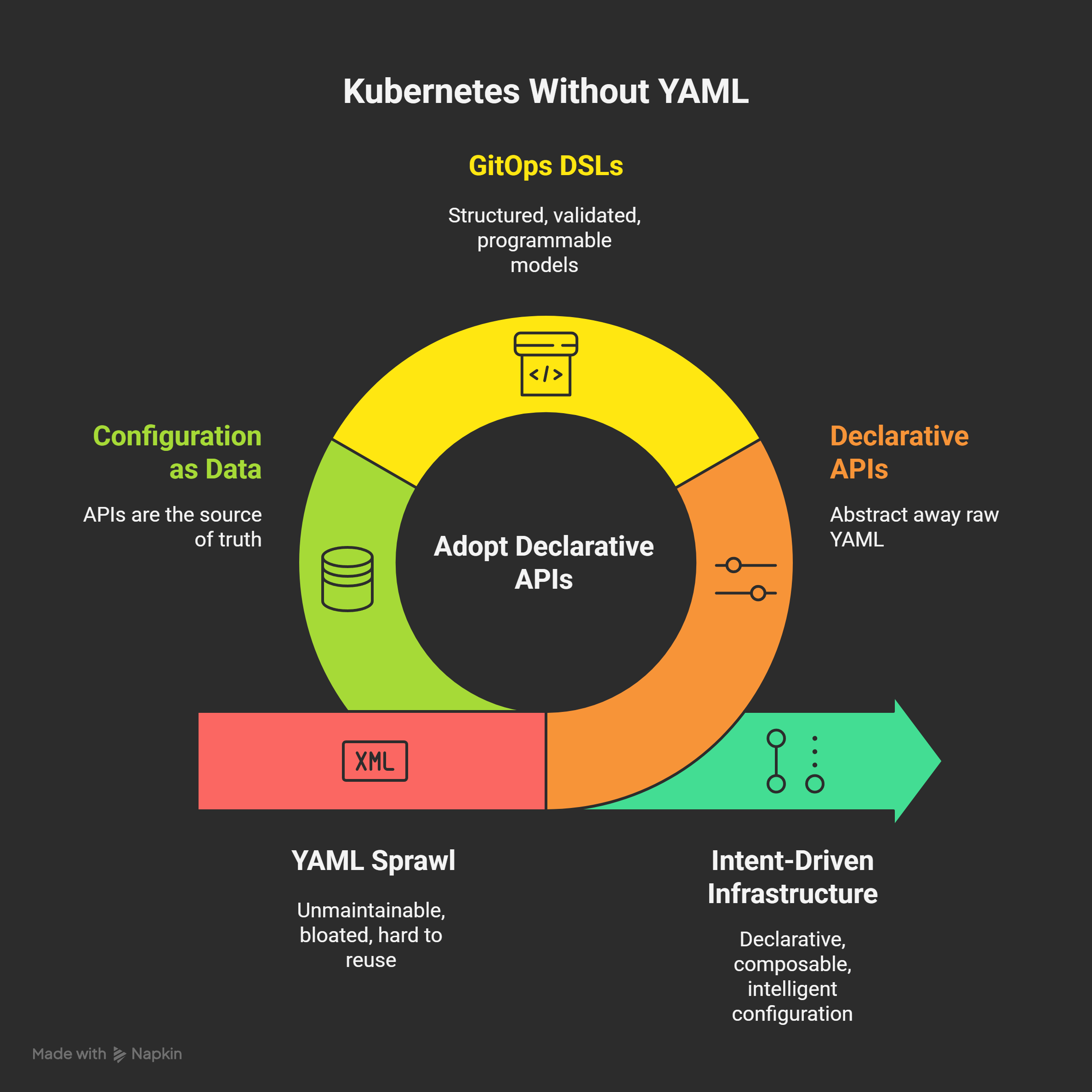
The Kubernetes ecosystem is shifting toward declarative APIs and GitOps DSLs that retain the intent of YAML but replace it with structured, validated, and programmable models.
These new tools treat cluster configuration as data-driven code — easy to reason about, reuse, and validate.
🧠 3. Declarative APIs: The Next Step in Kubernetes Evolution
Modern Kubernetes controllers like Crossplane, Flux, and KubeVela introduce declarative APIs that abstract away raw YAML definitions.
For example, in Crossplane, you can define a database instance with a single custom resource:
apiVersion: database.example.org/v1alpha1
kind: PostgreSQLInstance
metadata:
  name: my-db
spec:
  parameters:
    size: small
    version: "13"
  compositionSelector:
    matchLabels:
      provider: aws
Behind the scenes, this API calls AWS RDS, provisions a PostgreSQL instance, and manages lifecycle — no Terraform, no YAML sprawl.
🧩 These APIs make Kubernetes the “control plane for everything” — cloud resources, databases, and services.
💻 4. GitOps DSLs: Declarative, Not Imperative
GitOps DSLs (Domain-Specific Languages) like CUE, Jsonnet, and Pulumi YAML-less frameworks are redefining how we express Kubernetes configurations.
🧱 Example in CUE
deployment: {
  apiVersion: "apps/v1"
  kind: "Deployment"
  metadata: name: "web"
  spec: {
    replicas: 3
    template: spec: containers: [{
      name: "nginx"
      image: "nginx:latest"
      ports: [{ containerPort: 80 }]
    }]
  }
}
This single CUE definition is:
- ✅ Validated and type-safe
- 🔁 Composable (you can reuse “modules”)
- 🧩 Automatically rendered to valid Kubernetes manifests
Result: You write logic once and generate YAML automatically when needed — or skip YAML entirely in CI/CD pipelines.
🧠 5. The Rise of “Configuration as Data”
Instead of “Infrastructure as Code” or “YAML as configuration,” the new paradigm is Configuration as Data.
That means:
- All configuration is version-controlled and declarative
- APIs, not files, are the source of truth
- Tools interpret the intent — not you
Think of it like this:
| Concept | Traditional YAML | Declarative API / DSL |
|---|---|---|
| Validation | Manual or runtime | Schema & compile-time |
| Modularity | Copy-paste | Reusable components |
| Reusability | Low | High (functions, templates) |
| Tooling | kubectl, Helm | CUE, Crossplane, Pulumi |
| Security | Manual reviews | Policy-driven validation |
🪄 6. Popular Tools Powering the YAML-less Future
| Tool | Purpose | Why It Matters |
|---|---|---|
| CUE | Declarative data validation and generation | Replaces raw YAML with schema-driven logic |
| Jsonnet | Data templating language | Simplifies complex manifests |
| Pulumi | Infrastructure as real code (Go, TS, Python) | Lets you use modern programming instead of YAML |
| Crossplane | Declarative cloud control plane | Converts YAML intent into managed resources |
| KubeVela | Application delivery platform | Provides developer-friendly declarative APIs |
| Flux & ArgoCD | GitOps orchestration | Automate delivery of YAML-less manifests |
Together, these tools are dismantling YAML’s dominance — replacing it with programmable, validated infrastructure definitions.
⚙️ 7. Example: Deploying Without YAML Using Pulumi
Pulumi lets you define Kubernetes resources in TypeScript or Python — with full language support and reusability.
import * as k8s from "@pulumi/kubernetes";

const appLabels = { app: "nginx" };

const deployment = new k8s.apps.v1.Deployment("nginx", {
  metadata: { labels: appLabels },
  spec: {
    replicas: 3,
    selector: { matchLabels: appLabels },
    template: {
      metadata: { labels: appLabels },
      spec: { containers: [{ name: "nginx", image: "nginx:latest" }] },
    },
  },
});

export const name = deployment.metadata.name;
✅ No YAML
✅ Full TypeScript validation
✅ GitOps-friendly — commit code, and ArgoCD/Flux can still deploy the output
🧩 8. Why GitOps DSLs Are the Future
GitOps introduced the idea that Git is the single source of truth — but that truth doesn’t need to be YAML anymore.
Declarative DSLs enable:
- Schema enforcement before merging to Git
- Composable infrastructure patterns (reusable modules)
- Integration with CI/CD, AI-driven automation, and code reviews
In short, the pipeline evolves from applying YAML → to applying intent.
🧠 9. Challenges & Considerations
- Adoption Curve: Teams deeply invested in Helm/YAML will need training and migration planning.
- Tool Fragmentation: Too many DSLs can create silos — standardization is key.
- Interoperability: YAML will remain the common export format for now.
- Governance: Strong policy enforcement (OPA/Gatekeeper) must accompany flexibility.
The good news? Many of these DSLs output YAML under the hood, ensuring compatibility while you transition.
🚀 10. The Future: Declarative, Composable, Intelligent
By 2026, most Kubernetes-focused organizations will have moved away from hand-written YAML toward declarative APIs and programmable GitOps workflows.
Imagine:
- Defining a new app deployment with a single line of CUE
- Validated by AI-driven policy checks
- Automatically deployed by GitOps
- No indentation errors ever again 😎
That’s not science fiction — that’s the YAML-less Kubernetes reality emerging right now.
🧰 Conclusion
YAML got us here — but it won’t take us further.
Declarative APIs and GitOps DSLs represent the next leap in how humans communicate intent to machines.
Kubernetes is evolving from “managing YAML files” to operating intent-driven infrastructure.
And that’s a shift every DevOps engineer, SRE, and platform team should start preparing for today.