
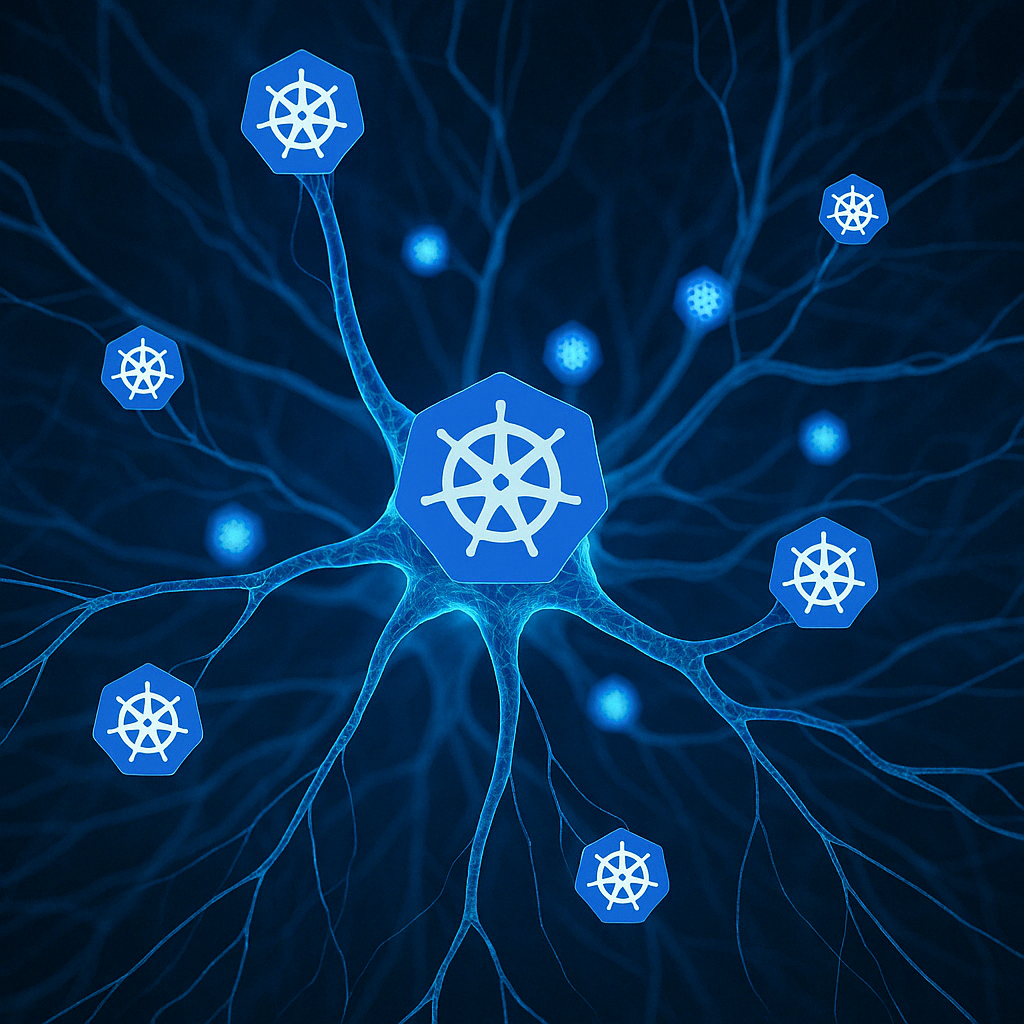
Kubernetes is widely viewed as a tool — an orchestrator, a system. But what if we looked at it through a completely different lens?
Imagine Kubernetes as a living digital organism: one that grows, heals, adapts, and evolves. This perspective isn’t just poetic — it can fundamentally shift how you design, debug, and operate clusters.
Let’s explore this wild idea. 🌱
🧠 1. The Brain: The Control Plane
Just like your brain controls body functions, the Kubernetes control plane (API server, scheduler, controller manager) coordinates every action across the cluster.
- Scheduler = Nervous system: Decides what “limbs” (nodes) execute which tasks
- API server = Sensory cortex: Accepts input from the outside world (kubectl, GitOps)
- Controllers = Hormones: React to environmental changes (like failing pods)
🧬 You’re not managing infrastructure — you’re nurturing intelligence.
🩹 2. Self-Healing: The Immune System
Kubernetes is famous for auto-healing: if a pod fails, it respawns.
- Like white blood cells, controllers detect and remove “unhealthy” parts.
- Probes (liveness/readiness) act like immune sensors, checking system health.
- Horizontal Pod Autoscalers mimic growth hormones, reacting to load stress.
💡 Think biologically, and troubleshooting becomes pattern recognition.
🦠 3. Pods as Cells: Specialization & Multiplication
Each pod in Kubernetes can be seen as a cell — with a specific job.
- Replicas = Mitosis: Cells replicate under demand.
- Init containers = DNA loaders: Prepare the cell for its role.
- Sidecars = Symbiotic organelles: Help process, store, and transmit data.
🔁 Your microservices aren’t just components — they’re organs in a living body.
🧬 4. Network as Circulatory System
- Services and DNS = Arteries: Route nutrients (requests) to the correct cells.
- CNI Plugins = Capillaries: Facilitate the final delivery of packets at the pod level.
🧠 Want better traffic flow? Think about blood pressure and blockages.
🌍 5. Cluster Federation = Digital Ecosystem
Multiple clusters working together? That’s a multi-organism system, like a coral reef.
- They exchange energy (data), balance resources, and respond to environmental shifts.
- Think multi-cloud or hybrid clusters as biodiversity — adding resilience.
🐙 Don’t just deploy — design an ecosystem.
🧪 Why Does This Matter?
Viewing Kubernetes as a biological system helps:
- 🔍 Shift debugging from “what broke?” to “what’s disrupting the organism?”
- 🧘 Encourage adaptive design — using auto-scaling, self-healing, and observability together
- 🌐 Rethink multi-cluster design not as infrastructure, but as ecosystem design
✨ Closing Thought
Kubernetes isn’t just a tool. It’s a living, breathing digital organism that reacts to its environment, heals its wounds, and evolves with your application needs.
Once you start seeing it this way… you’ll architect differently, debug faster, and build clusters that thrive like nature itself. 🌱💻