

Kubernetes Interview Questions and Answers – Set 1
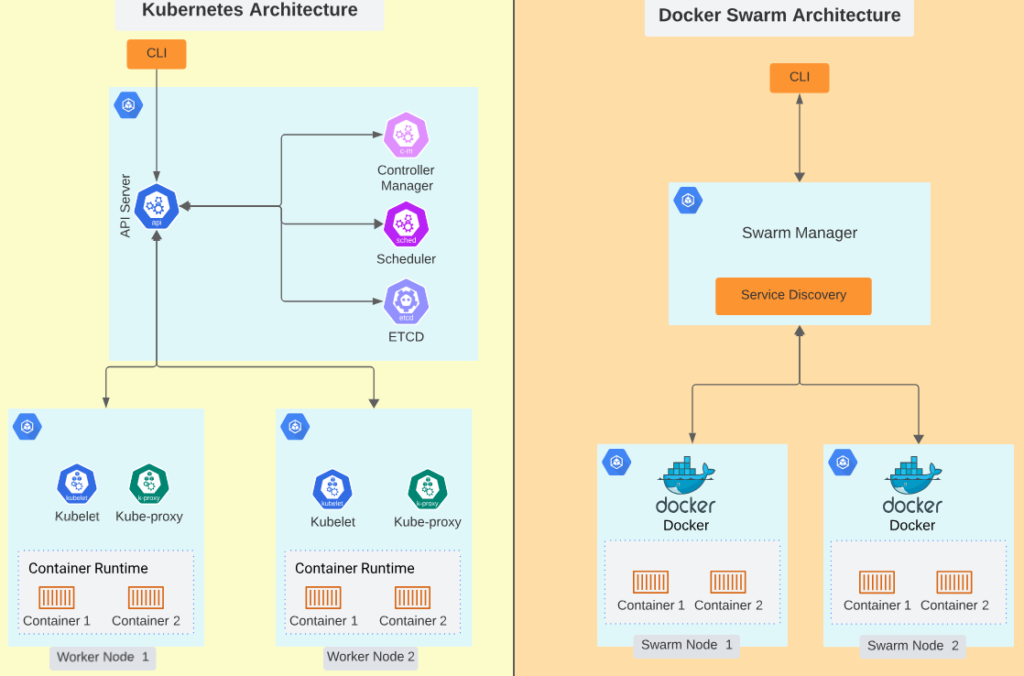
1) Differentiate between Kubernetes and Docker Swarm.
There are certain features and on the basis of those features we will differentiate between Kubernetes and Docker Swarm.
Scalability: Kubernetes (thousands of nodes) vs Docker Swarm (smaller clusters)Complexity: Kubernetes (steeper learning curve) vs Docker Swarm (simpler)Deployment: Kubernetes (rolling updates, self-healing) vs Docker Swarm (rolling updates only)Networking: Kubernetes (comprehensive) vs Docker Swarm (simplified)Security: Kubernetes (advanced) vs Docker Swarm (basic)Community: Kubernetes (larger) vs Docker Swarm (smaller)
Choose Kubernetes for large-scale, complex deployments, and Docker Swarm for smaller-scale, simpler use cases.
2) Explain Kubernetes.
The Kubernetes is designed and developed by Google. And it can be defined as an open-source orchestration tool. In other words, Kubernetes is an open-source container manager. It helps the user to organize, scale, and automate many large containers.
As it is developed by Google it doesn’t have to prove its excellence. In layman's terms, we can call Kubernetes a solution for the management of multiple containers.
3) Define the relation between Kubernetes and Docker.
Docker delivers a facility to manage the lifecycle of a container, while it also helps in building the run-time container. Well, Docker may help in building run-time containers and so on but the Docker container cannot communicate. These containers need a platform to communicate.
This is where Kubernetes plays a crucial role in arranging communication between the Docker containers.
4) Describe Container Orchestration.
There are certain micro-services provided to every application. And those micro-services can serve only when they are synchronized well. The synchronization of the micro-services is highly important, in order to run any application in a seamless manner.
In such cases the container orchestration comes into play, in layman's terms orchestration is known as the fusion of different types of instruments to produce a great piece of music.
The role of container orchestration is to fuse different components of an application to deliver a smooth service.
5) What is the necessity of Container Orchestration?
A number of micro-services are installed in the container of an application. Without the micro-services, the application can’t perform specific functions. And the containers that contain the micro-services can only work when they will communicate with each other.
Here inter container communication is necessary to perform certain activities in the application. In such conditions, the container orchestration tool comes into play.
The container orchestration basically synchronizes all the containers containing micro-services.
Kubernetes Interview Questions and Answers – Set 2
6) Explain the process of simplification of containerized deployment with Kubernetes.
Every application contains a group of containers that tend to run across a number of hosts. Well in order to perform well, these containers need to communicate with each other.
And the communication of these containers is possible by means of Kubernetes. Kubernetes is basically cloud-agnostic and is designed in a certain way to allow communication between multiple containers. And this is how the deployment of containers takes place.
7) Define the clusters in Kubernetes.
Basically, Kubernetes is designed in such a manner that it allows the developers to feed cluster services and each service is designed according to a certain configuration.
After feeding the cluster services with the desired codes and commands, then the cluster will automatically run configuration in the infrastructure.
8) Define Heapster.
Kubelet provides data and this data run on each node. But these data need are needed to be aggregators.
This is where the Heapster comes into play and aggregates all data that are supplied by the Kubelet. Now this container is generally supported by the cluster of Kubernetes and it runs like a pod.
Then it finds all other clusters and examines the information used from the nodes of Kubernetes. This is done with the help of a non-machine agent.
9) What do you by minikube?
The minkube can be defined as the tool that helps to run Kubernetes in a localized manner or locally. This in return leads to running Kubernetes in a virtual machine.
10) Define Kubectl?
The kubectl can be defined as a platform that can be used to pass the commands to the cluster. In other words, it delivers commands to the CLI to run against the Kubernetes clusters.