
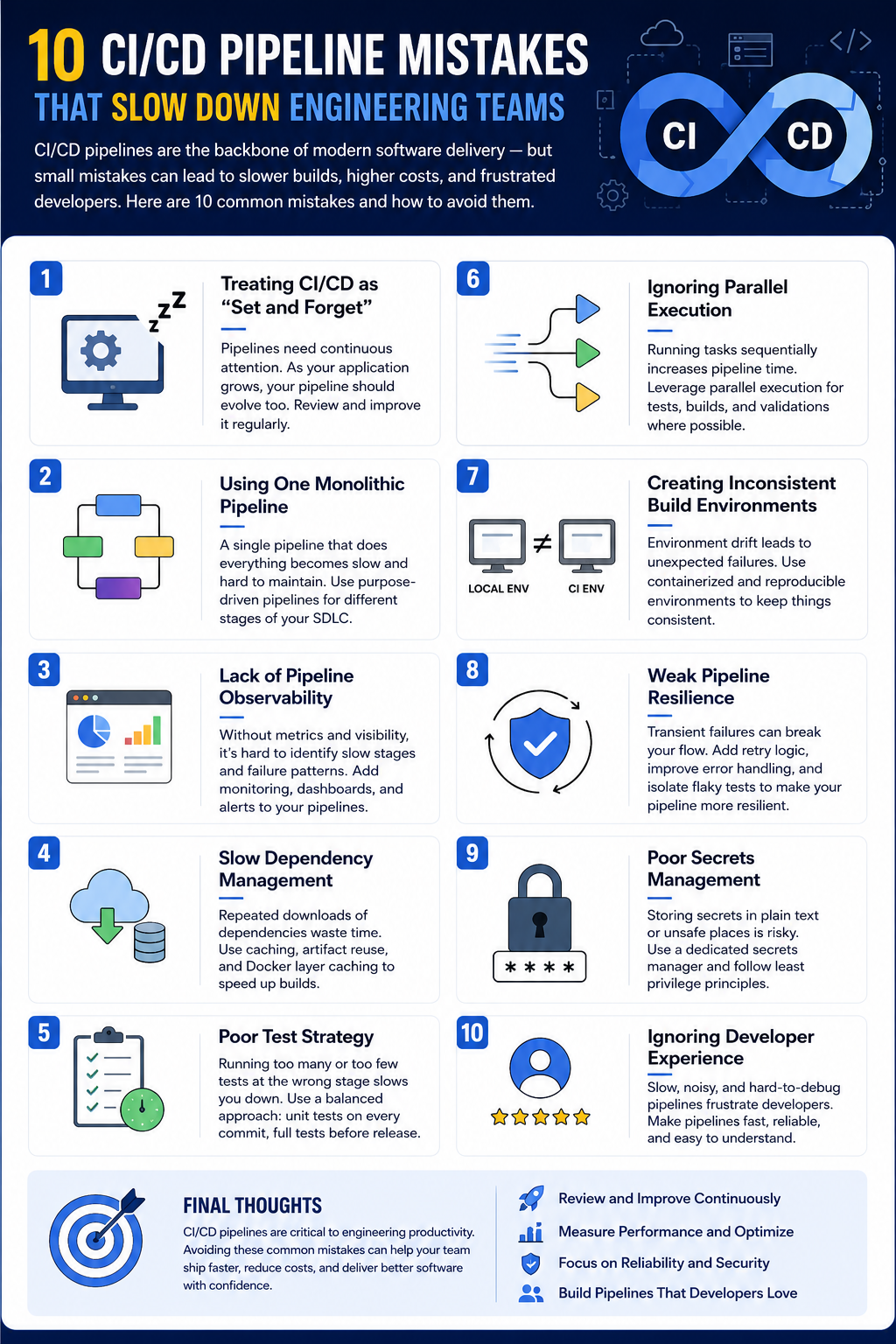
In modern software delivery, CI/CD pipelines are the backbone of speed, consistency, and reliability. They help engineering teams build, test, and deploy code quickly while keeping releases predictable across environments.
But as systems grow, pipelines often become a hidden bottleneck. What starts as a simple setup for a small project can gradually turn into a slow, fragile, and expensive process. More repositories, larger test suites, increasing team size, and poor pipeline design can all lead to slower feedback cycles, higher infrastructure costs, and reduced developer productivity.
In this article, we’ll look at 10 common CI/CD pipeline mistakes that slow down engineering teams and how to avoid them.
1. Treating CI/CD as “Set and Forget”
A common mistake is to set up a pipeline once and never revisit it. As the application grows, the pipeline also needs to evolve, but many teams fail to update it regularly.
Over time, test suites expand, build steps multiply, and repository complexity increases. Without regular review, the pipeline becomes slower and harder to maintain.
CI/CD pipelines should be treated as living systems. Teams should regularly monitor pipeline performance and refine workflows as the software matures.
2. Using One Monolithic Pipeline
Another frequent issue is building one large pipeline that handles everything: linting, testing, packaging, security checks, and deployment. While this may seem convenient at first, monolithic pipelines are difficult to scale and maintain.
A better approach is to split the workflow into purpose-driven pipelines:
- Quick validation pipelines for pull requests.
- Extended test pipelines for merges.
- Release deployment pipelines for production releases.
This structure gives developers fast feedback while preserving strong validation before deployment.
3. Lack of Pipeline Observability
Most engineering teams invest heavily in production observability, but CI/CD pipelines often receive far less attention. When builds slow down or fail frequently, teams struggle to answer basic questions:
- Which stage is taking the longest?
- Which repository triggers the most builds?
- Where do failures occur most often?
Without metrics, logs, and dashboards, bottlenecks remain invisible. Adding observability to CI/CD pipelines helps teams identify slow stages, detect reliability issues, and improve overall stability.
4. Slow Dependency Management
Large projects often waste significant time repeatedly downloading dependencies from external registries during pipeline runs. This creates unnecessary delays and adds avoidable network dependency.
You can improve this with:
- Dependency caching.
- Docker layer caching.
- Artifact reuse across pipeline stages.
Even modest caching improvements can dramatically reduce build times and improve developer velocity.
5. Poor Test Strategy
Testing is essential, but the wrong testing strategy can easily slow pipelines down. Some teams run the full test suite on every commit, which creates long feedback cycles. Others test too little and end up relying on manual validation later.
A balanced testing strategy works better:
- Unit tests on every commit.
- Integration tests on merges.
- Full regression tests before release.
This approach gives developers quick feedback without sacrificing quality.
6. Ignoring Parallel Execution
Many pipelines still run jobs one after another simply because that was the original setup. This sequential execution wastes time, especially when independent tasks could run simultaneously.
Modern CI/CD platforms support parallel execution for tasks like:
- Running multiple test suites.
- Building microservices independently.
- Performing validation checks at the same time.
Using parallelism can significantly shorten pipeline duration and improve release speed.
7. Creating Inconsistent Build Environments
Environment drift is one of the most frustrating causes of CI/CD failures. If developers build code locally in one environment, but the pipeline uses a different runtime or dependency set, failures become inevitable.
This often leads to the classic problem: “It works on my machine.”
Using containerized build environments or other reproducible setups keeps local development and CI behavior aligned. Consistency across environments reduces surprises and improves confidence in the pipeline.
8. Weak Pipeline Resilience
Builds can fail for temporary reasons such as network instability, flaky tests, or short-lived dependency issues. If the pipeline is not resilient, these transient problems turn into repeated interruptions.
A resilient pipeline should include:
- Retry logic for temporary failures.
- Isolation of flaky tests.
- Clear and actionable error messages.
Improving resilience reduces unnecessary rebuilds and helps developers stay focused on actual code issues.
9. Poor Secrets Management
Security is often overlooked when pipelines are first created. Credentials may be stored directly in configuration files, plain environment variables, or other unsafe locations.
This becomes especially risky when CI/CD systems interact with multiple services, environments, and infrastructure components. Secure secrets management should be a core part of pipeline design.
Best practices include:
- Using a dedicated secrets management system.
- Rotating credentials regularly.
- Limiting secret access to only what is necessary.
Strong secrets handling reduces security risk without slowing development.
10. Ignoring Developer Experience
CI/CD pipelines exist to help developers ship software faster. But when they become slow, noisy, or hard to debug, they do the opposite.
A poor developer experience usually looks like:
- Slow feedback cycles.
- Unclear failures.
- Unpredictable execution.
- Hard-to-diagnose issues.
Good pipelines should feel almost invisible to developers. They should be fast, predictable, and easy to understand so teams can focus on delivering software instead of fighting the pipeline.
Final Thoughts
CI/CD pipelines are more than support infrastructure. They are a critical part of how modern engineering teams build and deliver software.
As systems grow, pipelines must evolve with them. Regularly reviewing pipeline design, observability, performance, testing strategy, and resilience can unlock meaningful gains in engineering productivity and system stability.
Even small improvements, such as better caching, clearer pipeline stages, or stronger observability, can have a lasting impact on delivery speed and developer satisfaction.